
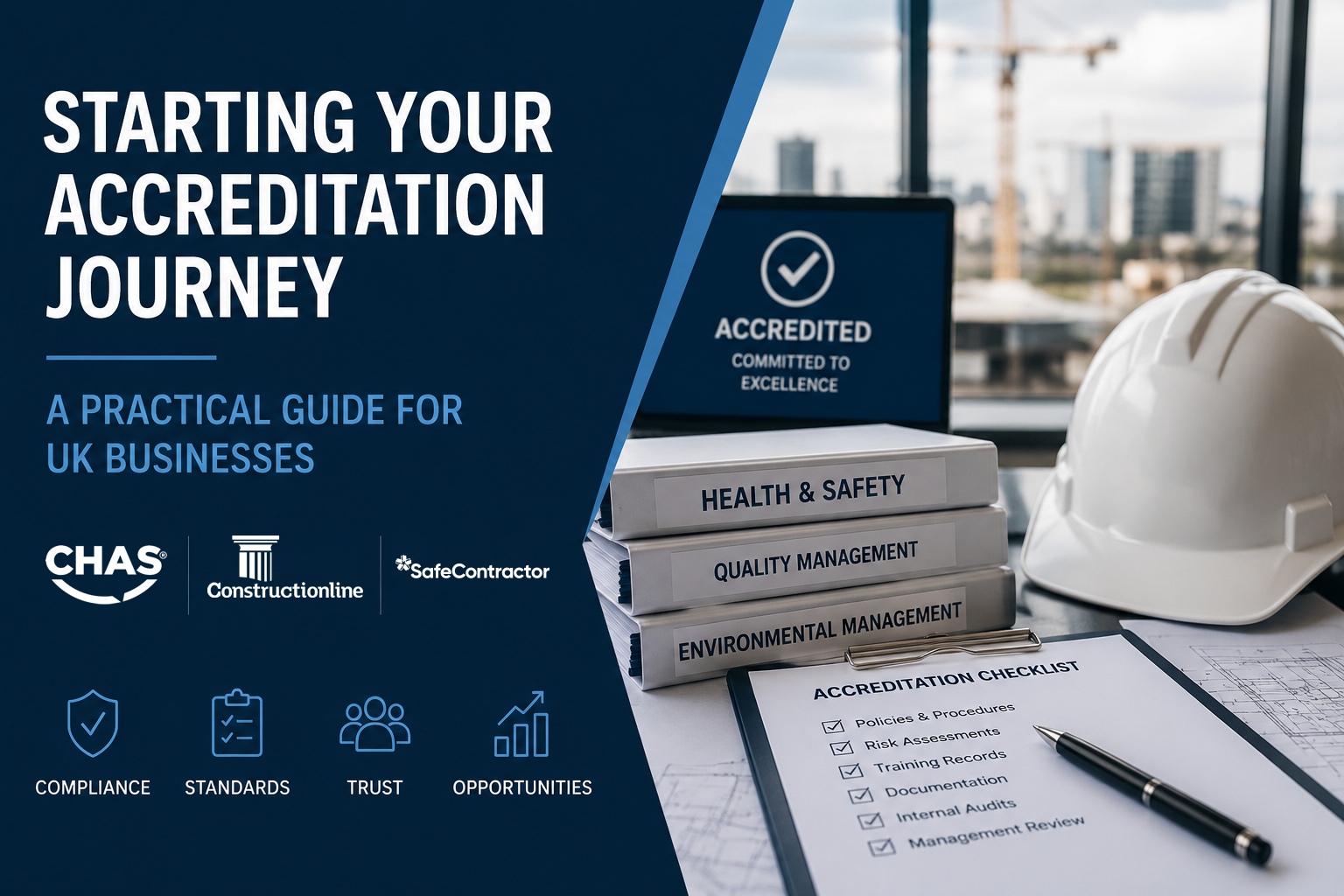
Starting Your Accreditation Journey: A Practical Guide for UK Businesses
For many UK businesses, accreditation, certification and supplier approval schemes can feel complicated. With different standards, schemes and assessment routes available, knowing where to begin is often the hardest part.
The best starting point is simple: understand exactly what your business needs, why it needs it and what your client or target market is actually asking for.
At Barlow & Co Ltd, we help businesses make sense of those requirements and prepare for independent assessment without creating unnecessary paperwork.
Why Consider Accreditation or Certification?
Businesses usually pursue accreditation, certification or supplier approval because they need to:
- Meet a client or contractual requirement.
- Qualify for tenders or approved supplier lists.
- Strengthen health and safety or compliance arrangements.
- Improve internal systems and processes.
- Demonstrate capability to customers and procurement teams.
- Access new commercial opportunities.
Before applying for anything, ask:
What has my client, buyer or target market actually asked me to provide?
That question can save significant time and money.
Step 1: Identify the Right Scheme
Not every accreditation or certification is suitable for every business.
Consider:
- Your industry.
- The work you carry out.
- Client requirements.
- Contract and tender requirements.
- Relevant legal responsibilities.
- Your future growth plans.
For example, construction contractors may be asked for CHAS, SafeContractor, Constructionline or the Common Assessment Standard, while businesses in other sectors may need ISO 9001, ISO 14001, ISO 45001 or ISO/IEC 27001.
Choosing the right route from the beginning can help avoid paying for a scheme or certification that your customers do not actually require.
Step 2: Review What You Already Have
Many businesses already have some of the evidence needed for an application.
Review existing:
- Policies and procedures.
- Risk assessments and method statements.
- Training and competence records.
- Insurance documents.
- Quality and environmental arrangements.
- Company records.
- Compliance documentation.
This helps identify genuine gaps instead of unnecessarily recreating documents that are already suitable.
Step 3: Understand the Requirements
Different schemes assess businesses in different ways.
Before starting, establish:
- What documents are required.
- What supporting evidence is needed.
- Whether the assessment is desktop-based or includes an audit or site visit.
- Whether implementation needs to be demonstrated.
- What happens if further evidence is requested.
- How renewal or reassessment works.
Understanding the requirements early can make the application easier to manage and help reduce avoidable delays.
Step 4: Prepare the Necessary Systems and Evidence
Successful assessment is not simply about producing policies.
For schemes and standards that assess implementation, your documentation should reflect how the business actually operates.
This may involve:
- Defining roles and responsibilities.
- Formalising working procedures.
- Keeping appropriate records.
- Managing training and competence.
- Monitoring performance.
- Reviewing and updating documentation.
For other supplier schemes, the main focus may be providing specific policies, records and supporting evidence.
The documentation should always be appropriate to your business rather than relying on generic paperwork that does not reflect what you actually do.
Step 5: Involve Your Team
Where compliance requirements affect day-to-day work, employees need to understand their responsibilities.
This may include:
- Communicating procedures.
- Providing relevant training.
- Maintaining competence records.
- Encouraging feedback.
- Keeping information up to date.
A system works much better when the people using it understand why it exists and what is expected of them.
Step 6: Consider Professional Support
External support can be particularly valuable when you are applying for the first time or dealing with a complicated buyer requirement.
A compliance consultant can help with:
- Identifying the correct scheme.
- Reviewing client requirements.
- Carrying out a gap review.
- Organising evidence.
- Developing agreed policies and procedures.
- Preparing for assessment.
- Responding to assessor queries.
Professional support cannot guarantee approval, but good preparation can help reduce avoidable mistakes and administrative delays.
Step 7: Prepare for Independent Assessment
Once your documentation and evidence are ready, the relevant assessment, verification or certification can take place.
Depending on the scheme, this may involve:
- Reviewing submitted documents.
- Checking supporting records.
- Assessing management arrangements.
- Carrying out an audit or site visit.
- Requesting further evidence.
- Raising corrective actions where required.
Keeping your records accurate, current and organised can make this stage significantly easier.
The final decision on approval, membership or certification always remains with the relevant independent scheme provider, assessor or certification body.
What Happens After Approval?
Compliance should not stop once you receive a certificate, membership or supplier approval.
Depending on the scheme, you may need to:
- Renew annually or at another defined interval.
- Update policies and supporting evidence.
- Monitor insurance and certificate expiry dates.
- Maintain training and competence records.
- Complete surveillance or reassessment activities.
- Respond to changes in standards or client requirements.
Keeping everything organised throughout the year can make future renewals and assessments much easier.
How Barlow & Co Ltd Can Help
At Barlow & Co Ltd, we support UK businesses with accreditation, certification and supplier-compliance requirements including CHAS, SafeContractor, Constructionline, the Common Assessment Standard and ISO management systems.
We can help you understand what is being requested, identify evidence gaps, organise documentation and prepare for independent assessment.
Our approach is practical and straightforward. We focus on helping you provide the evidence you actually need rather than creating unnecessary paperwork.
Already Been Asked for an Accreditation or Supplier Requirement?
If a client, principal contractor or procurement team has asked you for CHAS, Constructionline, ISO, the Common Assessment Standard or another supplier requirement, send us the details.
We can help you understand what you actually need before you commit to an application.
The final assessment, verification or certification decision remains with the relevant independent scheme provider or certification body.
Not Sure What Accreditation You Need?
Send Barlow & Co Ltd the requirement you have received and we will help you understand the next steps.
Send us the requirement you received
We will use a free 15–20 minute initial call to clarify the likely next step. Detailed document analysis is scoped separately.