
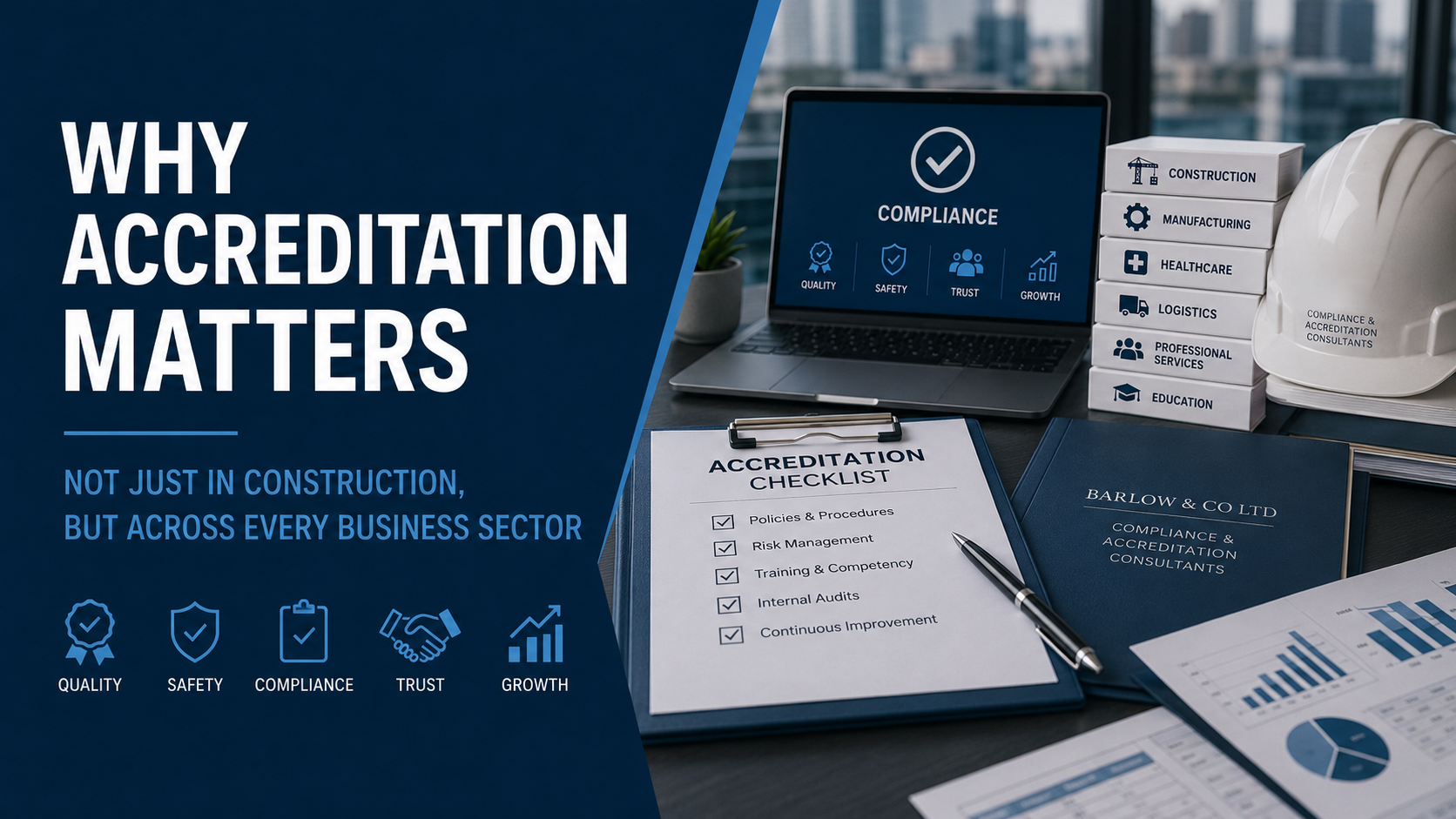
Why Accreditation Matters: Not Just in Construction, but Across Every Business Sector
In today’s competitive marketplace, recognised accreditation, certification and supplier-assurance schemes can play an important role in demonstrating how a business manages quality, safety, compliance and continuous improvement.
At Barlow & Co Ltd, we understand that independent assessment can provide reassurance to clients, contractors, procurement teams and other stakeholders by showing that a business has been assessed against defined requirements or recognised standards.
For many organisations, these schemes can also help strengthen supplier credentials, support tender submissions and demonstrate a structured approach to managing key business risks.
What Is Accreditation?
The term “accreditation” is often used by businesses as a general description for external compliance and approval schemes. In practice, different routes use different terminology.
For example, organisations can be certified to ISO management system standards, while supplier schemes such as CHAS and Constructionline use their own certification, assessment, verification and membership arrangements.
Depending on the scheme or standard, businesses may be asked to provide evidence relating to areas such as:
- Health and safety
- Quality management
- Environmental management
- Information security
- Staff training and competence
- Policies, procedures and management arrangements
- Legal and regulatory responsibilities
Successful assessment can provide evidence that specific requirements have been reviewed by an independent organisation. However, the scope and level of assurance will depend on the particular accreditation, certification or supplier scheme involved.
The Importance of Accreditation in the Construction Industry
Construction businesses operate within a demanding regulatory and commercial environment, often involving significant health and safety risks, contractual requirements and detailed supply-chain assessments.
Recognised accreditation, certification and supplier schemes can help contractors demonstrate that they have appropriate management arrangements in place.
Depending on the scheme, this may include evidence that a contractor:
- Has established health and safety management arrangements.
- Maintains relevant policies, procedures and records.
- Manages workforce training and competence.
- Has processes for managing quality and environmental responsibilities.
- Understands relevant legal and contractual requirements.
- Can provide the evidence requested by clients and procurement teams.
For buyers, this can provide additional confidence that a contractor has undergone an external assessment or verification process.
Some clients, principal contractors, frameworks and procurement exercises also require particular certifications, supplier memberships or pre-qualification standards before a business can tender for or undertake work.
Accreditation and Certification Across Other Business Sectors
The value of independent certification and supplier assurance extends well beyond construction.
Businesses operating in manufacturing, engineering, logistics, facilities management, healthcare, professional services, technology and many other sectors may benefit from recognised certifications and external assessment schemes.
The most appropriate route will depend on the organisation, its customers, the sector in which it operates and the requirements it is being asked to meet.
Building Trust and Credibility
Trust is an important part of any successful business relationship.
Independent certification or supplier verification can help businesses demonstrate that specific systems, processes or evidence have been assessed against defined requirements.
This can give customers, contractors and procurement teams additional confidence when assessing a potential supplier.
Demonstrating a Structured Approach to Compliance
Businesses face a wide range of legal, regulatory, contractual and customer requirements.
Accreditation, certification and supplier-assurance schemes can help demonstrate that appropriate management arrangements are in place to address relevant requirements.
However, holding a certificate, membership or accreditation does not replace a business’s responsibility to understand and comply with the law or guarantee that every legal requirement has been met.
Improving Efficiency and Performance
Preparing for certification or external assessment often encourages businesses to review the way they operate.
Clearer responsibilities, better document control, improved record keeping and more consistent processes can help businesses identify gaps and opportunities for improvement.
Where these systems are implemented effectively, they can support greater consistency, efficiency and service quality.
Supporting Business Growth
Some public-sector buyers, larger commercial organisations, principal contractors and supply chains require suppliers to hold particular certifications, memberships or pre-qualification credentials.
Having the appropriate approval in place can help a business meet supplier-selection requirements, strengthen tender submissions and access opportunities for which it may otherwise be unable to qualify.
The important point is to establish exactly what the customer or procurement process requires before investing in a particular scheme.
Encouraging Continuous Improvement
Many certification and supplier-assurance schemes require businesses to maintain their documentation and evidence over time.
Depending on the scheme, this may involve annual renewal, surveillance, reassessment or further verification.
This can encourage organisations to regularly review their systems, update evidence and address areas that need improvement rather than treating compliance as a one-off exercise.
Providing Assurance to Clients
When selecting a contractor, supplier or service provider, buyers often want evidence that the organisation has appropriate systems and controls in place.
Independent assessment can provide an additional level of assurance by confirming that specified requirements have been reviewed by an external organisation.
The level of assurance provided will always depend on the scope of the particular certification, accreditation or supplier scheme.
Barlow Helping Clients Prepare for Independent Assessment
At Barlow & Co Ltd, we understand how important accreditation, certification and supplier approval schemes can be when businesses are looking to demonstrate strong standards of professionalism, safety, quality and compliance.
We help clients prepare for independent assessment by identifying evidence gaps, organising documentation and making sure their policies, procedures and supporting information are ready for review.
Whether in construction or another sector, recognised accreditation and certification schemes can help businesses demonstrate that they have appropriate systems and processes in place and can strengthen their position when tendering for work or joining approved supplier lists.
While accreditation does not replace a business’s legal or regulatory responsibilities, independent assessment can provide valuable assurance to customers, contractors and procurement teams.
At Barlow, our role is to make the preparation process clearer, more organised and less stressful, while the final assessment, verification or certification decision remains with the relevant independent body.
Need Help With Accreditation or Certification?
If a client, contractor or procurement team has asked you for CHAS, Constructionline, ISO or another supplier requirement, send us the details and we’ll help you understand what you actually need.
Send us the requirement you received
We will use a free 15–20 minute initial call to clarify the likely next step. Detailed document analysis is scoped separately.